As is known, the technique we call VSM (Value stream mapping), or value stream analysis, is a highly effective technique for seeing losses. Very successful applications can be made in production processes. In many of our projects we have applied it successfully in identifying the company's current state and in setting its future targets. It is an ideal method for enabling us to follow the basic data needed to manage the company's change and to keep it progressing on the right path, and for managing the work to be done within a project.
When office processes are involved, value stream mapping needs to change. A different point of view is required at many points. For example, cycle time is not data that can easily be obtained in office processes, and even if it is obtained it does not carry the same meaning as in production. In this respect Makigami stands out, because it does not require working with symbols and because it brings the visual aspect to the fore by drawing on large sheets of paper. Today it appears as a technique used especially for mapping office processes.
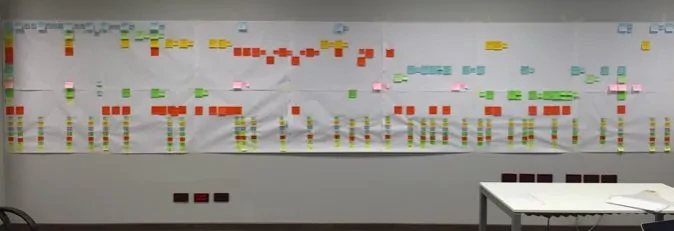
What is Makigami?
Its literal meaning can be translated from Japanese as "roll of paper." As a lean production technique, Makigami is a process analysis method developed for examining a process in depth. The entire process is drawn on a large visual board (it can also be on paper in roll form). - At first glance, Makigami is a paper-and-pencil tool.
- Any process can be examined with Makigami.
- Makigami is a team tool; it can be carried out through teamwork
- Makigami leads to major improvements and changes; in this respect it is a kaikaku tool, not a Kaizen tool.
Who developed Makigami?
As far as I know, Makigami was first used in 1996 by Isao Okmura (Fujico company). Its basic purpose is to examine the process by visualizing it and to make problems visible.
How is Makigami applied?
Drawing with paper and pencil
Traditional Makigami is prepared by directly using paper, pencil, colored marking materials, and the forms used in the process. Working in this way both enables the process to be understood more quickly and allows the changes to be made easily. Being done on roll paper helps you take it down and store it easily. Thus, when you are going to work on it, you open it, carry out the necessary work, and then take it down and store it. It does not need to stay on the wall for a long time. A Makigami includes the following:
- All activities performed by everyone involved throughout the process
- All documents/media used throughout the process
- Communication links
- Time analysis
- Problems identified
Making problems visible
As I stated at the beginning, Makigami is for processes whose product is not physical, such as office processes. When the process is like this, losses are generally greater than when the product is tangible. Makigami aims to reveal these unseen and/or unknown losses. In the lean production system these losses are known as the 7 Muda:
- Errors,
- Waiting,
- Motion, transportation,
- Repair, correction
- Unnecessary production,
- Unnecessary processing,
- Inventory
Identifying work that does not create added value
The most important result of Makigami as a lean production system tool is that it focuses on work that does not create added value and, by bringing forward especially the invisible items, ensures that they are made visible. Within a process, Makigami finds the times that do not create added value by looking at matters such as response time and work handoff, which increase the process's losses and slow the flow. The basic target should always be to shorten the process's response time. In this way, everything that does not create added value will disappear.
In fact, there is so much time around us that does not create added value, that is, that we define as Muda, that we often lose the overall view needed to notice it. It is precisely at this point that Makigami and value stream mapping (VSM) come to our aid. With the help of this technique we can focus on the overall picture and make the changes that will provide flow. Identifying Muda can differ somewhat in office processes. For example, inventory in an office environment should be treated as requests that are waiting, for example in a purchasing process. For this reason it is useful to be very careful and to examine the process in detail. It may be necessary to examine for a longer time rather than making a quick decision.
