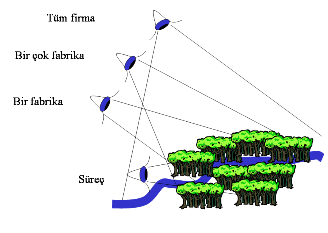
It is all of the work, whether it creates added value or not, done for the product or service offered to the customer to come into being. Value stream analysis is the examination of all processes from concept to application, and from raw material until the product is delivered to the customer.
Value stream analysis is a tool consisting of paper and pencil. It shows the product and information flow within the process; it is a visual made by hand. It helps us see and understand how material, product, and information flow within the process
Why?
Value stream analysis should be the starting point for implementing the Lean Production System. The basic reasons for this are the following:
· Small improvements are made, but the company does not progress on the path of the Lean Production System.
· Model changeover time decreases, but it has no effect on inventories.
· Most importantly, flow cannot be created and there is no improvement in the company's costs
· The work that is done does not contribute to the creation of added value.
· As a result, resistance to change within the company increases.
How?
When value stream analysis is carried out, the process, the value stream within the company, the value stream between companies, and the entire value stream are reviewed in that order. When value stream analysis is carried out, the following steps are applied.
· The products produced are divided into groups according to their characteristics. A value stream analysis is applied for each product group. Process maps are used to divide the products into groups. (See Preparing a process map)
· The company's current state is entered on the current value stream map.
· The target value stream map is then determined. In this way, the state to be reached can be understood by the project team, and management gains the opportunity to measure the result of what is done.
· A work plan is prepared in order to reach the target.
Preparing the current value stream map
It is the value stream map that shows the company's actual state. In the context of showing the actual state, this map should be prepared entirely by hand, using paper and pencil, without using data from computers and similar systems. In this way it should be ensured that the project team has thoroughly understood the system, and the ground will have been prepared for preparing the correct target value stream map.
The steps for preparing a value stream map have been set, in order, as collecting customer data, collecting process data, collecting material and product data, collecting information-flow data, and creating the timeline.
The following symbols are used when value stream analysis is carried out.

Collecting customer data
If possible, customer data is collected by contacting the customer directly. Information such as the average annual, monthly, weekly, and daily order quantity, the shipment type, special packaging information, the customers' location information, and the like is collected. This information will later be used together with the other information.
Collecting process data
Process data is collected step by step, starting from the point closest to the customer and working backward. Process data consists of the following: material and product inventory quantities, information about the people who perform the operations, working time, duration, number of personnel, cycle time, Overall Equipment Efficiency (OEE) rate, model changeover time, scrap rate, and similar data are collected.
Collecting information-flow data
The best method of collecting information-flow data is to move together with the information and/or the product. In this way you can collect all the information without missing anything. The information to be collected is gathered according to who gives information to whom, when, and about what. The information may be order information, production orders, production plans, sales forecasts, inventory forecasts, and similar information.
Preparing the value stream map
The value stream map is drawn using the symbols above. Using the standard system during drawing is important so that everyone understands the same result from the symbols and the abbreviations. For a sample value stream map, click here...
Preparing the target value stream map
Preparing the target value stream map determines the form the company will take in the future. Thus, in order to determine the improvement work to be done, the differences between the current value stream map and the target value stream map, and what needs to be done to eliminate these differences, are examined. When the target value stream map is prepared, the "Lean Principles" below are used.
Lean principles
Lean principles can be defined as "Flow", "Takt Time", and "Pull System".

Click here for a sample value stream map...
